Presenting for your twisted pleasure three more dishes on the menu of the diner on the road to Perdition. Enjoy your meal…
Getting Lucky
Play the hand you’re dealt, the saying went, but George Vale never put much stock in that. Fate had dealt him an awful hand, and he didn’t have a play to make, never had. Scrawny, with bland, unattractive features, he’d been ignored by his father, bullied at school, and pushed aside by the go-getters in the workplace. His facility with arithmetic had landed him this job as a bank teller. It paid well enough to afford a decent studio near the bank, food, a few nice suits, and the occasional treat, but he already knew that he would retire as a teller even if he gave fifty years to the bank.
Fate.
George hardly gave it a thought anymore. It was just the way it was. Life’s a bitch, and then you die. Another saying he’d read, this one on a bumper sticker. It was more accurate than most.
It was George’s turn to lock the door this week, which meant he would close his window a half-hour early, verify his balance sheet for Mr. Granger, lock the door, and let each of the late-banking patrons out as they finished their transactions. So it was that he was able to leave for the night at 6:10 this Monday. The other tellers would spend a half-hour working on their balance sheets before they could head for home. A good week.
He bought an evening newspaper and made his way to the bus stop. He would be home early every night this week, and looked forward to a quality frozen dinner and some educational television. Such were the treats in his life. He sat down on the covered bench and held the folded paper on his lap; the bus would be here before he had time to read anything. He would do that at home.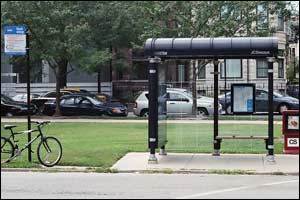 He had a nice view while he waited. There was a clean, well-manicured park across the street, and laughing children romped on the grass in the shade from the nearby trees. A line of traffic stopped at the signal, a large truck blocking his view, but when it moved away there was a new addition to the scenery. A young woman, a brunette with a rich, smooth tan, perhaps even Eurasian or Mulatto, certainly exotic in any case, had sat down on the matching bench across the street. Her short summer frock provided him an underview of her athletic thighs, and George, a shy man with a powerful leg fetish, soaked up the view like a sponge. Then his bus arrived and he was swept away to his empty, sterile apartment to face his newspaper, a frozen dinner, and some television shows he found himself unable to concentrate on.
*
Tuesday dragged on interminably as George thought frequently of the mystery woman, whether she would be at the bus stop again tonight, and what she might be wearing. Six o’clock arrived and George dutifully manned the door, fighting down his impatience to bid a cordial good evening to each late banker. When the last one left it was only 6:01, and he fairly flew out the door, skipped the newspaper, and took his seat on the bench.
The woman arrived shortly thereafter, once again the traffic clearing to reveal her already seated, legs primly crossed this evening, watching the traffic pass with alert and shining eyes. Once she caught his eye. Her head tilted after a moment, and she lifted her hand, palm out. Was it a wave? He couldn’t tell, and tried to act like he wasn’t watching, looking down the street at the suddenly-fascinating traffic signal at the corner. His bus arrived, and he was away, and not without a sense of relief. If she thought he was spying on her, well, an angry woman could make a great deal of trouble for a man like George in this day and age.
*
Wednesday, chastened by his near escape, George paid much more attention to the minutiae of his job, and wasn’t so eager to head for the bus stop; he wasn’t upset when he didn’t get out the door until 6:17, and he stopped to buy a paper on his way.
The traffic was in place when he sat down, and when it moved, there she was, seated primly, knees together, in another of her delightful floral miniskirts. She didn’t seem to notice him, and he opened his paper, only allowing himself an occasional brief glance in her direction. During his third glance, she turned her body and leaned to the side, digging for something in the large purse on the bench beside her. As she did, her knees began to drift apart until for the briefest moment, George was sure he could see a powder blue strip of cloth in the darkness between. The poor man’s eyes almost fell out of his head!
The traffic intervened again, and he returned to his paper, savoring the memory, and thankful that she hadn’t caught him.
Or had she?
When he looked again, her eyes were locked with his. Her expression was unreadable, neither angry nor pleased.
Had she seen him? What must she think? Would she report him?
Thankfully his bus arrived to take him away from her inscrutable gaze.
*
Thursday the last customer was out the door at 6:08. George was in no hurry to leave, but it had to be done, and he followed the plan he had formulated the previous evening, turning off the main street, walking around the block, and going to the next stop two blocks up the street. He had no idea what she might or might not have seen, but he would take no chances further angering an outraged feminist. If she had seen him come out of the bank, and complained to Mr. Granger… Well, he only had two more evenings of door duty, and it would be easy enough to ensure that she never laid eyes on him again.
He carried out his plan of evasion, and was happy not to see her walking on the street. She had to arrive at her bench from somewhere, and that was his final worry. Happy as he could be, he boarded his bus and found an open window seat half way back. As the bus pulled into traffic, he studied the sidewalk opposite, verifying that he had made good his escape.
He leaned back and pinched the bridge of his nose, the tension headache from worrying about this all day already beginning to dissipate. He had just drawn a sigh of relief when someone who had already been on the bus approached from behind and slid into the seat next to him.
It’s her! Oh, my God, take me now!
“What are you . . .” he started to blurt.
“Doing on this bus?” she finished in soft, dulcet tones.
“Well . . . Yeah. You go the other way.”
“I go whichever way I choose. Always have. I was surprised when you didn’t get on at your usual stop. Are you trying to avoid me?”
“Avoid? No, not at all. I had to stop at a shop is all.”
His heart was racing like a woodpecker at full throttle, and he considered reaching for the cord and bailing out at the next stop.
“Don’t do that,” she said as if reading his mind. “I like to get to know my admirers. My name’s Angelique. What’s yours?”
“George,” he said shyly, nervous, sure she was collecting information for her complaint.
“That’s nice,” she said. “A lot of kings have been named George. Are you headed home?”
“Yes.”
“And do you have a boring little wife waiting for you?”
“No, just my cat, and I’m pretty sure she considers me boring. Just like everybody else,” he added before he could stop himself.
“You’re funny, George,” she said with a smile. “I like you. Would you like some company tonight?”
“Who, you?”
“Who else?”
“I don’t know. Girls like you only talk to me to make fun before they have their boyfriends beat me up.”
“Do you hear me making fun, George? Do you see a boyfriend anywhere?”
“Well . . . No.”
“No, you don’t. I attract the sort of men you speak of in bunches, like grapes. They are all arrogant and full of themselves, and always telling me what I have to do to make them look good and keep them happy. But you, George, you are not like them. You are quiet and unassuming, and I’ll bet you would be happy to have a friend like me.”
“Mayyybe,” he said, drawing the word out as he considered the prospect.
“Of course you would, George. How many women like me come to you offering their friendship? A lot? Do you see so many that I am not interesting to you?”
“No, nothing like that.”
“Well, if I represent an opportunity for you, then you should grasp it. I promise, you won’t lay on your death bed bemoaning the fact that you didn’t spend more lonely nights with your cat. What do you say, George? Let’s go to your place, watch an old movie, and get to know each other better.”
His heart was pounding for a completely different reason now.
*
She stood beside him as he fitted his key into the lock with a trembling hand. The door popped open and he gestured her into his private sanctum. Inexpensive but neat furniture, a small TV, and a sofa-bed stood around a small combination living- and bedroom, with a small kitchen beyond.
“I’m sorry,” he told her,” starting toward the kitchen, “all I have is frozen dinners. They’re making them pretty good these days.”
“Maybe we’ll go out later,” she said in a tone that made him turn to face her. She had her blouse pulled out of the waistband of her skirt, and was unbuttoning the row of small pearl buttons down the front. “Why don’t we get comfortable?”
With her blouse halfway unbuttoned and her cleavage fully exposed, she stepped into him, pushed his suit jacket off his shoulders, and began to unbuckle his belt.
“Mmmmm, I hope I don’t hurt you when I unzip these.”
Blood roaring in his ears now, George forgot his milquetoast past. All the dues he had spent his life paying were about to pay off in spades. He shrugged his jacket off and reached to finish releasing the buttons of her blouse, her small but perfect breasts turned up as if seeking the touch of his mouth. She hooked her thumbs in the elastic waistband of her skirt and pushed it and her satin panties to the floor, exposing her most intimate treasure to his gaze.
A gaze that ignored that prize entirely, fixated as it was on the long tail that curled around from behind her, pointing at him with its arrowhead-shaped terminus. Dropping her fully unbuttoned blouse to the floor, she stepped into him, wrapping her arms around his neck and pressing those perfect breasts into his chest as a pair of leathery wings spread from behind her to enfold him.
“So, sweetheart,” she said, lisping around the fangs beginning to fill her mouth, “shall we get started?”
+ + + + +
Membranes
When I wrote this almost a decade ago, it was for a steampunk anthology, hence the weird backdrops and car that never existed. Don’t pay too much attention to that; that isn’t the story at all…
* * *
“There are more things in heaven and earth, Horatio, than are dreamt of in your philosophy.”
~ William Shakespeare, Hamlet
* * *
 “Mr. Potter. Mr. Potter, you need to wake up. There are some people here to see you.”
Lucius Potter opened his eyes to see a stark white ceiling, bundles of copper pipes running across it, one of them taking a 90° turn and descending to his bed. For bed he was in, and he could tell by the sweat on his stiff back that he had been there for some time. He looked around to find that he was in a hospital bed. The copper pipe protected pneumatic tubes serving several instruments beside him, one monitoring his breathing, and another his heart. Now he felt the stretchy rubber band around his chest.
“Where am I?” he asked in a weak voice.
“You’re in Saint Mark’s hospital,” the elderly doctor beside his bed told him, “and you’re lucky to be here.”
“Saint Mark’s? In London? How did I get here?”
“You were brought by ambulance from the Eldergrove Clinic. They didn’t feel they could save you. They didn’t want to move you, either, but they felt that you would at least have a chance with us.”
“What happened to me?”
“We aren’t exactly sure, but… Look, you were found with your injuries among several other people in an abandoned house in the St. Stephen area. You were the only survivor of whatever happened, and the police are here to talk to you. Given the circumstances, I can hardly prevent it.”
“Police?”
“That’s what happens when half a dozen people are murdered, Mr. Potter,” said one of the two men behind the doctor.
“I caution you, detectives, Mr. Potter is in a very delicate condition, and you must not upset him. He was close to death when he came here two days ago, and there hasn’t been a great deal of time for recovery since then.”
“Don’t worry, doctor, it will be kid gloves all the way.”
“I appreciate that. Mr. Potter, this is Detective Merriweather and Detective Carstairs from Scotland Yard. They need to ask you about what you saw the night all those people were k-… attacked. Detectives, I’ll trust you to be gentle. Mr. Potter’s constitution won’t stand up to much.”
“We understand, doctor. We just need to gather some facts. We’ll be the soul of gentility.”
As the doctor pushed the curtain back to leave the bedside, Carstairs stepped out and pulled a second chair to the beside. He and Merriweather both sat down, and Carstairs took out a dark green, top-bound notebook.
“Mr. Potter,” the big man said, “my name is Eli Merriweather. This is Bennet Carstairs. We’re detectives from Scotland Yard. The reason we’re talking to you is that you were pulled from an abandoned house. The police found seven people in the cellar of that house, and all of them were dead except you. We’re very interested in finding out what happened there, and you’re the only witness. We’d be very grateful if you could take us back to the night they died and tell us what happened.”
“I’m not sure what happened myself,” Potter said. “It all happened so suddenly.”
“Relax, Mr. Potter,” Merriweather said. “Just start from the beginning. How did you come to be in that house in the first place?”
Potter instinctively didn’t care for Merriweather. A big man in an ill-fitting suit with a bowler, he was the embodiment of everyone who had ever teased, taunted, and bullied him throughout school and the years after. He reminded himself that Merriweather was not one of those people, and considered what to tell him. The truth would brand him as a lunatic, but what else could explain what had happened in that house?
“I guess it all started with Daria.”
“The woman we found?”
“Yes, she was the only woman with us. It must have been her.”
“Tell us about her. How did she start the events.?”
“Daria… her last name was Jardin, by the way. French. She was a beautiful girl. You need to understand, no one like her had ever given me the time of day before, so when she suggested that she found me intelligent and even attractive… Well, I guess I was a bit too eager to follow her lead.”
“Her lead into what?”
“Daria was into the black arts. Ghosts, seances, fairies, you probably know the list.”
“Uh-huh.”
“Well, we got together, the group I mean, at one person’s house or another and held seances or played with a Ouija board. Silly stuff, you know, all good fun.”
“Yeah,” Carstairs interrupted. “This group you speak of were the seven people we found at the house?”
“Mostly. There was an eighth, but he wasn’t with us that night.”
“We’ll get to him later,” Merriweather said. “What were you doing in that house?”
“It was Daria’s idea. She showed us an old book she had gotten hold of. It looked really ancient, and she swore it was bound in human skin. She said it was an ancient coven’s spell book, and that it held instructions for rituals beyond anything we’d ever tried before. She wanted to try to open a portal to the afterlife, but she said she needed a large, secluded area for the ritual.”
“Did you believe she could really do this, Mr. Potter?”
“Not at the time, no. She couldn’t produce ghosts or meaningful messages on the Ouija board, so I didn’t see any possibility that she might succeed at this.”
“Why did you go along with it, then?”
“Look at me, detective. You may be amazed to hear this, but I don’t attract a great number of women. Daria was the most exciting thing that had ever come into my life. If she’d said she was building a rocket to the moon, I’d have been out there with her, turning a wrench.”
“All right, Mr. Potter, I can understand that. So, why were you in that house? Did one of you own title to it?”
“No. That was Frank’s doing. Frank Furman. He’s a bit rough around the edges, you know. He said he knew the perfect place, and took us to that old house. It did seem perfect. There were holes in the roof, the furniture was rotted, it was obvious that no one had been in there for years. It had some land, gardens maybe, surrounding it that offered seclusion, and Daria said it was perfect. We had a few meetings there, seances mostly, asking permission of the dead to open her portal.”
“And did they give their permission?”
“I never saw anything in particular happen, but Daria claimed they had told her we were accepted, so she went ahead with the preparations.”
“What sort of preparations?”
“She had us set up crosses in the cellar where we would do the ceremony, collect berries of a certain color. I couldn’t find any, so I bought some from the market. She didn’t know. Well, I don’t think she did. She even had Frank steal some holy water from a church. Then, on the night of the ritual, we gathered at the house and she made her preparations. We gathered around the septagram she’d drawn on the floor in blood—”
“Whose blood?”
“Sheep’s blood, detective. We bought it from a butcher. She turned an electric torch on a mirror she’d hung so that the beam illuminated the center of the septagram. Then we gathered around it and concentrated on the candle that was placed in front of each of us. She began to chant the spell. I believe it may have been in Latin, and then…”
His voice trailed off, and Merriweather noted that the machine tracking his heart rate was racing, showing a number on its dial that would have been normal for a sprinter.
“What happened then?” Merriweather asked after a moment.
“Then that, those things came out and began to attack everyone. One of the others was thrown on top of me. There was screaming and blood everywhere, and something squishy, entrails maybe, and then I passed out. I guess they overlooked me, covered by the body as I was. I remember being carried out, and I woke up a couple of times, but I didn’t really become coherent until I got here.”
“You expect us to believe—” Carstairs started.
“Ben!” Merriweather said, holding up a finger. “Mr. Potter, that’s an incredible story.”
“It’s the God’s truth, every word of it.”
“All right, we’ll have to check it out. Why wasn’t the last member of your group present?”
“Daria said the ritual called for seven. We drew straws to see who stayed behind.”
“All right. We’ll need the name and address of this ninth member.”
“Of course. His name is Edward Marston. He lives with his parents in Marylebone. It’s eighty-four Kensington Lane.”
“All right. We’ll need to talk to him, too.”
“I don’t see why. He wasn’t there.”
“Routine procedure, Mr. Potter.”
“Are you going to the house where this happened?”
“Of course.”
“Be very careful, detective. No one was left to send those things back. If they’re gone, you need to destroy the septagram, the candles, everything to do with the ritual.”
“We’ll look into it, Mr. Potter. You just get some rest now.”
“It’s imperative that the portal be destroyed!”
“You just relax. We’ll take care of everything.”
*
“What do you think, Ben?” Merriweather asked as they climbed onto their Richardson Catalytic Carriage. “Did he do it?”
“I don’t know, he looks pretty small,” Carstairs replied, opening the valve to allow the fuel to begin dripping on the catalyst. “He might have surprised them, but if they beat him down as badly as he was, he couldn’t have finished the job in the condition he was in.”
The gas pressure quickly reached its operating range, and Carstairs guided them away from the curb.
“What about this stuff he wants us to destroy?”
“The evidence in a crime, you mean?” Merriweather gave a harsh, single-syllable laugh. “Now, why would he want us to do that?”
“Oh, I can’t think of a single reason, unless he really believes all that manure he was spreading back there.”
“Well, he went through a pretty bad experience if he didn’t do it. Maybe he’s hallucinating.”
“How’s that, Doctor?” Carstairs asked.
“I’ve been reading about this new brain science, alienism, they’re calling it. Sometimes when a person’s mind goes through a profound shock, like seeing all your friends killed for example, it retreats into the darker corridors and begins to make up things that never happened, and these can be as real to the victims as this street is to us.”
“Well, if that doesn’t take it!”
“Take what?”
“Listen to me, Eli. This is a prime example of why a copper shouldn’t be too educated. You start looking for things to refute the evidence.”
“Refute? It’s part of the evidence.”
“Eli, think about what you’re saying. We have multiple murders with a sole survivor. What does that suggest to you?
“I know, but that kid’s size and build suggest otherwise.”
“Yeah,” Carstairs said. “They suggest that he had help. That’s why we’re going to size up this Marston fellow.”
“What’s the motive?”
“Maybe he was sweet on the girl, and she was displaying the goods for someone else. Or maybe Potter was, and he got Marston to help him somehow. We’ll find out when we get there.”
“Fair enough,” Merriweather allowed, “but maybe they’re all innocent. Here’s an abandoned house in a deteriorating neighborhood, some kids in there performing some weird ritual, and some vagrants see a chance to rob somebody. Robbery goes bad, the kids get killed. If they were all like Potter, they couldn’t have put up much of a fight.”
“If, Eli, if! You’re assuming unnecessary suspects. We’ve got all we need with Potter and Marston.”
“Unless they didn’t do it.”
“Well, we’ll have that worked out soon enough. This is Kensington Lane.”
“Look at these houses,” Merriweather said. “Not quite mansions, but not quite like where I grew up, either.”
“Nor me,” Carstairs agreed. “‘Course if we had, we wouldn’t likely be coppers, now would we? There, that’s eighty-four.”
He turned the light carriage into the drive and parked behind an elegant brougham, its horses nowhere to be seen.
*
Carstairs studied the oversized ornate door as they waited after pulling the bell rope. Teak, he decided, not quite ebony, a thick slab of wood richly carved with a lion’s head, a tiny door visible inside its mouth where anyone in the house could open it to examine the guests. It opened now.
“May I help you, gentlemen?” came a voice from within the house.
“Yes,” Merriweather said, pulling back his jacket to show his badge to the tiny door. “We’re Merriweather and Carstairs from Scotland Yard. We’re here to see Edward Marston.”
“Young Mr. Marston has just learned of the death of a friend. He is not receiving visitors today.”
“He’ll be receiving us,” Carstairs began before Merriweather held up a hand to cut him off.
“Sir, I appreciate that you have a job to do. We do also, and investigating a mass murder takes precedence over someone’s day of rest. Mr. Marston can talk to us here, or down at the Yard, if he prefers.”
The small door closed and the larger one opened, revealing a stout, dignified gentleman in a butler’s livery. “If you gentlemen will wait here, I’ll convey your conditions to Mr. Marston.”
The butler unhurriedly climbed the curving stairway and disappeared down a hallway as the detectives took in their surroundings. Sumptuous furnishings, nice paintings and statuary, but none of them renowned or bearing the patina of age; appropriate for the neighborhood.
After a few moments, a young man in plain trousers and a smoking jacket came down the stairs at a fairly brisk pace. He stopped at the landing to take them in, then walked slowly down to join them in the foyer.
“Please forgive my attire, gentlemen,” he said. “I had a bit of a blow last night, and I’m not in the mood to dress. I’m Edward Marston. How may I help you?”
“I’m Eli Merriweather and this is Bennet Carstairs. We’re detectives with Scotland Yard.”
“I’ve been half expecting you since I got the news,” Marston said, ushering them into an adjoining sitting room. Books lined two walls, and a wide row of windows opened onto a narrow garden with the drive and the street itself beyond. Marston was a strapping lad who filled the loose jacket when he sat down.
“And what news was this, Mr. Marston?” Carstairs asked.
“I went round last evening to call on a certain lady friend of my acquaintance, and her family told me she’d been murdered.”
“This lady friend wouldn’t happen to be Daria Jardin, would it?” asked Merriweather.
“Indeed it would. Can you tell me what happened?”
“Actually, we were hoping you could tell us. Where were you Saturday night?”
“Where was I? Why, does it matter?”
“It matters very much,” Carstairs said. “It’s our understanding that you were a member of a certain circle of friends, and that you were absent from their meeting Saturday night.”
“Yes, that’s true.”
“Why?”
“That was Daria’s choice. She was… Well, she was deep into the occult. I don’t believe in any of that jiggery-pokery myself, but she was a beautiful girl, one I was interested in courting, so I went along with it. Well, she’d found this old tome at a used book shop. Supposed to be some witches’ journal, or some such. It had a ritual that she was keen on performing that needed seven participants.”
“And there were eight of you.”
“That’s right. So she made us draw straws to see who stayed home, and I lost.”
“That must have upset you,” Merriweather speculated, “being cut out of a night in a spooky old house with a girl you had your eye on.”
“Aye, you’ve got the truth of it there, sir.”
“So what did you do to wile away the hours, then,” Carstairs asked. “Maybe go down there to have a bit of fun at their expense?”
“Of course not!”
“Why not?” the detective pressed. “You didn’t believe in that stuff, and here’s the girl, your girl, spending the night in the dark with half a dozen of your mates. I should think the temptation would have been irresistible.”
“That’s exactly why, detective. I don’t believe in this stuff, and if I’d gone down there to play a childish prank on something she took seriously, then when she found out, and she would have found out, I’d have been cut off from her forever. With due respect, sir, that would have been a bonehead move.”
“So, where were you, then?”
“I stayed home at first, but it started grating on me, so I went to a pub.”
“Which pub?”
“The Black Cat. My God, you think I killed her, don’t you?”
“Someone killed her, and most of her friends. We’re looking at every possibility. Did anyone see you at this pub?”
“Yes, it’s just a block over on the corner. I’m well known there. You said her friends. Was someone else killed?”
“All except one, and he was injured so badly that he may not live.”
“My God!” Marston leaned back in his chair and simply deflated. He no longer filled his jacket, and his chin quivered like a baby’s holding back a flood of tears. He bowed his head and covered his face to hide them.
“This is why establishing your whereabouts is so important,” Merriweather told him. “Somebody killed those kids, and in our experience, people are usually murdered by someone they know. We’re going to look at some other leads, but there’s a good chance we’ll be talking to you again. If you think of anything that might be helpful, don’t hesitate to get in touch with us.”
Marston had begun to sob, but managed a nod and a wave.
“We can show ourselves out.”
“Detectives,” pulling himself together as they started to go, “which one of them lived?”
“Mr. Potter.”
“Huh. Not who I’d have expected.”
“Why not?”
“Potter was a milquetoast, a bookworm. Most of the lads were in fine form. Two of them played rugby, one rowed crew. Potter was in the group because Daria said he was. He was good with books, and I think she found him useful for her research.”
“And for other things, maybe?” Carstairs asked.
“Don’t be ridiculous! Daria was a looker, and Potter would do anything she asked at the bat of an eyelash, but she had choices, and I don’t see Potter’s name being on her dance card.”
“All right. Thank you, Mr. Marston. We’ll be in touch.”
*
Carstairs pulled the Catalytic Carriage to the side of the road in front of the abandoned house where the grisly murders had been committed. Their visit to the Black Cat had confirmed Marston’s presence there until long after dark, which seemed to exonerate him from involvement unless they could construct a scenario in which he had butchered seven people first, then gone to the pub without a speck of blood on him, or a hair out of place. That would be difficult. In the meantime there was the scene of the crime.
The house was an aging two-story constructed on the vertical with a three-story tower at the rear corner. It sat in the middle of a large lot with a few dozen trees. Thickets of undergrowth had filled the untended spaces between during the generation it had lain untended. Offering both solitude and atmosphere, it wasn’t difficult to see why the young occultists had chosen it.
“It’ll be dark in another hour,” Carstairs pointed out.
“That’s all right, we have our carbides.”
Merriweather opened the box at the rear of the Phaeton, stood up the two formed backpack generators, opened the caps, and filled the reservoirs from a bottle of water. They put them on over their suit jackets, hung the lamps on their belts, and helped each other settle the packs comfortably. Ready for the coming darkness, they set out along the overgrown walkway toward the house. A constable stepped out from the trees on the left and asked their business there.
“Carstairs and Merriweather with the Yard,” Carstairs told him as they pulled their lapels back to display their badges. “We’re here to study the crime scene. It’s awfully nippy out here, son. Why aren’t you keeping watch from inside?”
“Not bloody likely, Gov. You’ll see when ye get in there. I’d not hang about in there with six of me roughest mates by me side. You mind yourselves in there, sirs. The place ain’t natural.”
“We’ll be fine, son. Carry on.”
“Very good, sirs.”
They continued up the steps and into the foyer, and the reason behind the constable’s reticence became immediately apparent. The light dropped instantly from even what had been present beneath the trees, shrouding the room in a spooky cloak of misbegotten shapes and threatening shadows. The air was tainted with mildew, and a ruined painting hung opposite the door, a corner of the canvas torn loose and hanging over the face. The doorway into the living room promised an even darker venue.
“Jesus,” Merriweather breathed. “And they wanted to come here in the dark?”
“I’m sure they brought their own lamps,” Carstairs ventured. “I think we’d better make use of ours.”
“Couldn’t agree more,” Merriweather said, turning his back so his partner could open the valve allowing the water to drip onto the calcium carbide. He returned the service for Carstairs, then opened the valve on his lamp. Catching the distinct garlic-like odor of the resultant acetylene, he struck a match and lit the flame. Carstairs did likewise, and with the two lamps glowing brightly, they stepped into the living room.
Here was the source of the mildew smell, at least a large part of it. The furnishings had been left when the owner had departed, and sofa and chairs were tattered, black with mold, bugs scattering from the light. Their footsteps raised puffs of spores from the blackened carpet.
“I see what he meant,” Merriweather said.
“What? Who?”
“The constable. Bad enough being in here with the lights.”
“Yeah. Great place for a spooky seance, though. Where do you want to start?”
“Well, the murders took place in the basement, so why don’t we check the upper floor first, see if maybe someone was waiting for them up there.”
“You know,” Carstairs said, “that could only be Marston. Only the group knew they were going to be here, and the other seven were the victims.”
“Who’s to say one of them didn’t tell someone?” Merriweather asked. “We can’t exactly ask them.”
“Yeah, I guess. What do you think we’ll find up there?”
“We’ll know when we find it. Maybe a place where somebody sat in a chair waiting.”
“If you think for one minute that anyone voluntarily sat on this furniture, you’re the one who needs an alienist. And what if we do find something like that? One of the kids might have come up here.”
“I don’t think so. They were here for one specific purpose. You know how focused young people are when they get the bit in their teeth.”
“Some of them. You obviously think there’s something up there worth seeing, so you go ahead and take a look.”
“What are you going to do?”
“I’m going to the place the murders were committed. That’s where the clues will be. You get through up there, come on down.”
*
Carstairs located the basement stairs off the kitchen, and started down. They followed the wall with a ninety degree turn at the corner where he noted a large bloodstain. Apparently one of the victims had made it this far before the killer had caught him. Him it had to be, for the only woman had been found on the basement floor.
The basement was a large square room covering most of the house’s floor plan, the open space broken only by thick wooden pillars a third of the way in from each wall. On one of these was an oval wall mirror probably brought from the house above, and tied to the beam in the center of the room was a dry-cell flashlight pointed at the center of it. The sheep’s blood had long since evaporated, but the remaining residue was sufficient to show where the septagram had been. Scattered candles littered the floor, and he noted fresh scuff marks where the old crates, trunks, and furniture had been pushed back against the walls to make room for the ritual. He leaned against the pillar opposite the mirror, taking in the septagram, the bloodstains where the youngsters had been cut down, trying to visualize the scene unfolding.
The stains were obviously where the people had fallen and died, and they were at widely separated points around the room. Carstairs couldn’t see how a single attacker could have killed six such widely separated people without using a gun, and there were no bullet wounds in any of the bodies. So, multiple attackers it had to be, then. None of the small windows around the top of the walls were broken, so they had to have come down the stairs. Did they sneak down? Rush? When did the kids become aware of them? What did they do?
He spun at a rustling sound and a loud squeak from the crates behind him, but the light revealed only the long tail of a rat disappearing behind the boxes.
Yecch! He turned back to resume his study of the scene.
*
Merriweather stepped out of the second bedroom, the aging floor creaking under his feet. It felt solid enough, not like the fifth step on the lower flight that had threatened to collapse beneath his weight, and he crossed the hall to the third bedroom. The powerful carbide lamp revealed more of the same, mold a half-inch thick on every cloth surface. The smell of mildew had faded into the background as his nose had become desensitized, but he had no doubt that it was everywhere, just as it had been downstairs, and he knew that breathing the stuff couldn’t be good for his lungs. He was about to leave when he spotted an off-white flash beside the bed. Moving the light closer, he saw that it was the butt of a hand-rolled cigarette, but without the signs of advanced age that everything else in the room exhibited. He picked it up, sniffed it. Normal tobacco, strong, but no sign of cannabis or other herbal enhancements.
Still, it proved that someone had been up here sometime in the last few days, but nothing beyond that. Carstairs was right, it could have been one of the victims. He was pondering how he might determine who it was when he heard the screaming begin.
It was loud and long, and came from downstairs.
“Ben!” he called.
Only more screams answered, suddenly becoming wet and muffled.
“Ben!” He headed down the stairs at a dead run, cracking the fifth step on the lower flight, but not breaking stride. The screaming had stopped.
He charged down the basement steps, but came to a halt at the landing, taking in the scene. A pair of legs, Carstairs’ legs, lay on the floor, the fabric of his trousers shredded and soaked with blood. From the knees on up, a writhing red gelatinous membrane was wrapped around his body, contractions and depressions making its surface ripple in the light of the lamp.
“Jesus Christ!” he screamed. “Ben!”
But Carstairs was beyond answering; his legs weren’t even moving anymore.
Panicked, Merriweather turned to run. His foot slipped on the bottom step, causing him to fall on his face. That was all that saved him, as another of the membranous creatures dropped in ambush from the ceiling, landing precisely where he would have been had he not fallen.
It reared up as Merriweather got to his feet, revealing its underside, a slimy surface punctuated with slits, sharp, chitinous blades working in and out of them, eager to taste his flesh. Frozen with terror, Merriweather stood rooted to the spot as the thing raised itself to his own height. He snapped out of it when the thing began to topple toward him, that bladed underside spreading wide to enfold him in its final embrace. He dodged toward the rail, swinging his lamp against the thing’s edge and pushing it toward the wall. He tried to dart past and almost made it, but as the thing overbalanced, its lower edge snapped up and wrapped around his foot.
The agony was instantaneous as the chitin blades slashed into his flesh. He screamed from the pain and slammed the lamp, his only weapon, down on the thing’s viscous upper side with no visible effect. On the third blow, though, the lamp’s glass lens broke, and the fire came into contact with it, causing its hold to loosen. Seizing the initiative, Merriweather held the flame against it and opened the valve to the maximum, making the flame as large as possible. The thing responded by releasing his foot and sliding out of reach.
Merriweather was certain that his foot had been amputated, or at least reduced to ground meat, but he found as the thing retreated that it still looked like a foot at least. He crawled up the stairs, holding his lamp in a death grip, hearing the wet slurping sounds that could only be the thing coming on his heels in pursuit. His desperate flight took him to the top of the stairs, and he turned to face the thing, brandishing his lamp like a sword. Crawling backward toward the living room, he called out for the constable.
No reply.
He crossed onto the filthy rug in the living room, keeping the creature at bay with his pathetically small flame.
“Constable!”
Still no answer.
He backed across the living room floor, the creature stalking him every inch of the way. It tried to circle to his left, and he moved the lamp left. It tried going back to the right, and again the lamp stopped its progress. Then a second one emerged through the doorway and began to slither toward him. He stopped at the door to the foyer, a bottleneck where he could hold them at bay. It wouldn’t be for long, though. He was losing blood, and once he weakened…
Then he looked down to the frayed edge of the rotting carpet and inspiration struck. He held the flame against the ancient fibers until a glow took hold and began to spread, then he went to work on the door frame. It was an old, thick pillar, and resisted burning, but the shredded wallpaper beside it caught in places and sent ribbons of flame up the wall. Still, the structure itself stubbornly refused to catch.
And then the constable was at his side pulling him away from the door.
“What are you doing, sir?” the lad shouted at him. “You can’t do that, the whole place will go up!”
“Good! It must!”
“No, sir, you’ll get us both into a sea of trouble. You have to stop!”
Now he was trying to take the lamp away from him.
“Get away, you fool, they’ll have us both!”
“Who will have us, sir?”
“Those things! Don’t you see them?”
“What things, sir?”
“The look like rugs, but they’re moving. Look, man!”
Merriweather pulled his arm away and went to work on the door frame again.
“They killed those kids, they killed Detective Carstairs, and they nearly took my foot off. Find me something that will burn!”
“I don’t know, sir. Setting fire to private property is a violation of—”
His words were cut short as one of the creatures braved the smoldering carpet to rear up and lunge at Merriweather. The detective avoided it, scooting back on hands and knees, but he lost the foyer door in the process. The creature and two more like it advanced from the living room.
“God damn it, man, get some leaves, rags, anything at all. If they get outside we’ll never stop them!”
Convinced at last, the constable dashed out the door as Merriweather tried again to light the carpet. The creature was rising to its attack posture again when the constable returned with his arms full of dead leaves.
“Put them right there,” Merriweather said, indicating the spot right in front of him. The man retained the good sense to place them in a pile, and Merriweather lit it with the lamp, causing the horrors to withdraw toward the living room.
“Get more! Leaves, papers, anything that will burn. We have to burn this place to the ground!”
The constable wisely brought another armload of leaves from the front of the porch and tossed them onto the fire, then moved out to collect some fallen sticks. Only when the front of the house was crackling enthusiastically did Merriweather allow the young policeman to move him to a safe distance, giving him the lamp and instructions to start more fires all around the house.
*
The old house was fully engulfed in the roaring inferno, and the constable, Quinn by name, had joined him on the seat of the Phaeton after binding his foot as best he could with both of their handkerchiefs. They could hear the bells of the horse-drawn fire equipment rapidly approaching as two constables rounded the corner two blocks away and approached on a dead run.
“What are we going to tell them, Mr. Merriweather?”
“Hadn’t much thought about it. The truth, I suppose.”
“The truth? You know, if we do that, they’ll have us in a padded cell by morning.”
“Well, it’s three meals a day, and a dry place to sleep. Small enough payment for saving the world, I’d say.”
“All right, Detective, the truth it is.”
The End
* * *
Death of a Clown
Douglas Peterson leaned back from his computer and ran his fingers through his greasy black hair. Investigative Journalist mocked him from below his name on a stained business card peeking from under a collapsing pile of papers. Top five in his college classes, yet unable to hold down a real job in a respectable newsroom, Peterson struggled with the idea that he might be just another hack in a world of professionals.
Nope, he chided himself, ain’t going down that road! He was every bit as good as those drones who slaved their lives away under an editor’s critical eye at AP or Reuter’s. He was the kind of peg that just didn’t fit into those carefully constructed holes. Besides, being a freelancer gave him the freedom to work whatever story he wanted, work it at his own pace in his own way without some meddling office manager trifling with his reporter’s instincts.
It also left him free to take inspiration where he found it, like from the half-empty bottle of Jim Beam that sat on the shelf above his cheap Fingerhut desk. He took it down and drained a healthy slug, capped it and put it back, then sat looking at it for a moment.
Nah, he thought. After lunch.
He scrolled up the page, looking for typos. The little bastards could ruin any story, and he hunted them down relentlessly. It wasn’t the sort of story that would endear him to the police, but it was the sort he was known for. His forte was speaking truth to authority, and it never occurred to him that that particular trait could have anything to do with the fact that he had spent the last decade plying his trade from a grubby apartment and being shunned by authority figures.
Cops Without a Clue, his working headline screamed, followed by a convoluted tale of incompetence that was peppered with phrases like “couldn’t detect their butts with both hands,” and “a police department unwilling to cooperate with members of the press.” That the two things might be connected was as far from his mind as life on a distant star.
The case was brutally simple. Allison Young, the nineteen-year old daughter of a city councilman, had caused a minor scandal for her father when she dropped out of Carlsbad State and enrolled at the Pinebroker Institute, a local fly-by-night business that billed itself as a “clown college.” Fights between her and her father became public knowledge, and culminated in her moving into a girlfriend’s apartment. Her only answer to the burning question of why was that she wanted to bring joy to people’s hearts, not take money from their wallets.
The graduate list of said Pinebroker Institute trumpeted a dozen or so names of supposedly famous clowns that Peterson had never heard of, and doubted anyone else had, either; what he got from the owner when he visited was a sales pitch in which Sal, a fat hippo of a man with dewlaps and a Jersey accent suggested that he, Peterson, could make a killing as a birthday party clown. Young had paid her $6,000 tuition in advance, completed the four month curriculum, and was last seen getting into makeup for her class’s graduation and award ceremony where she was to be presented with the Most Original Makeup award. When the graduates had assembled on stage and the audience of a few friends and families, padded out with mandatory attendance by the undergraduate students had been seated, Allison didn’t come out of the dressing room. He sent a classmate to fetch her, but she wasn’t there. The only sign of her was a tin of pancake makeup dropped on the floor and her rubber nose lying on the dressing table, glue in place, ready to attach. Her cell had been called, her parents, her roommate, but she was never heard from again.
The police had been notified, and they proceeded to interview everyone in the young woman’s life. Sal had been considered a person of interest, as had her roommate’s boyfriend, but every lead quickly evaporated, and the case went on the back burner. It likely wouldn’t have even stayed there but for the pressure applied by her father, and it was common knowledge that their working theory was that she had earned her diploma, lined up a job, and skipped out before the ceremony to leave the war with her father behind. There were hundreds of traveling carnivals that crisscrossed the country, not to mention fairs and circuses, and the odds against finding one clown among that group transcended astronomical.
But the story of a councilman’s missing daughter wasn’t the sort that would go away easily, and Peterson had found Councilman Young to be a readily talkative critic of the police. He considered Peterson his most cherished ally in his ongoing search, greeted him with a hug every time they met, and kept him appraised of every tidbit of information he laid his hands on. He had set up a hotline for sightings, and it had initially been swamped with calls from Point Barrow to Quezaltenango, but now, seven months in, those tips had largely dried up. Now, all that was left to Councilman Young was to berate the police for their inability to track down his daughter, and Peterson made it his holy crusade to give every criticism the public airing it deserved. This was the project he was working on when his printer suddenly clattered to life.
Bzzzzt, bzzzzt! Two passes across the paper, then silence.
What the hell? He hadn’t hit the Print button. He swiveled his chair to examine the paper that was feeding up through the slot.
Help me!
*
And so it began, with those stark words, “Help me!” Peterson at first thought there was a simple technical problem with his printer feed. Not being a techie himself, he enlisted the aid of a friend, who told him that sometimes a line could pick up some spurious atmospherics and run off a few letters on a printer, but it was strange for it to randomly crank out an understandable sentence. Dissatisfied with that answer, he brought in a professional at considerable cost who told him the same thing; it wasn’t likely, but it could happen.
It didn’t happen again for a few days, then, in a late-night session with a pint of 90-proof in his system, it came to life again. This time it spit out a name, Quinn Isaac. He looked it up in the 2006 issue of the telephone directory, the last one the library held, and found an address in a rundown neighborhood south of the college. He paid the man a visit.
“Quinn Isaac?” he asked the stringy-haired twenty-something who answered the door.
“Maybe. Who are you?”
“Douglas Peterson. I’m a freelance journalist—”
“Yeah! You’re that guy that hates the pigs! I read everything you write, man. What can I do for you?”
“I don’t actually hate the police, Mr. Isaac.”
“Oh, right, I get it. Wink-wink, nudge-nudge, am I right? That’s okay, your articles speak for themselves. So, what brings you down here looking for me?”
“I got your name from a tip line” — that wasn’t exactly untrue — “that suggests that you might know something about the Allison Young case.”
“Who told you that?”
“It was anonymous.” That wasn’t untrue, either. “Just a suggestion that I talk to you. Did you know her?”
“Yeah. Well, I didn’t know her, know her. She was my girlfriend’s roommate.”
“Did you ever do anything socially with her?”
“She came to the water park with us once. Ooh, that babe could fill up a bikini!”
“Did you have a thing for her?”
“Are you kidding? She was easy on the eyes, and that’s no joke, but you don’t stick your dick in crazy if you know what’s good for you.”
“She was crazy?”
“Probably not. Weird enough to keep me away, though. I mean, who the hell wants to be a clown? Everybody thinks you’re a whack job, and your career consists of scaring the b’jesus out of little children. Takes a special kind of weird, if you ask me.”
“Was she seeing anyone else when you knew her?”
“No, I don’t think— Wait a minute, there was this one guy. Chad, Champ, something like that. Big guy, real sourpuss. He went to that so-called school with her. Guy was bad news. Surly, hostile. I figured he was going to clown school so he could find more children to molest.”
*
That tip had led him back to Pinebroker, but there the trail went cold. He passed it to Sergent Jackson, the detective assigned to ignore Young’s case. She was very brusque, as always, but wrote the name down and told him she’d look into it. Detective Sergeant Gail Jackson. Face of an angel, body of a fitness model, and the personality of an angry badger… speaking of crazy! Peterson couldn’t leave her in the wake fast enough.
It continued for months. He’d be working himself to exhaustion, sleep-deprived, often hung-over, sometimes roaring drunk, and the printer would awaken to type the name of a person, a place, a date. It led him all over the Carlsbad Forest and into the mountains beyond, and every trip led him to a clue. Despite his complete disdain for Jackson, he always told her what he found, not for her benefit, though closing the Young case would represent a nice feather in her cap, but out of loyalty to Councilman Young and the daughter he knew only through photographs. Regardless of his intentions, he was constantly being helpful to her, and so was greatly surprised when she arrived at his apartment with a pair of uniformed gorillas to arrest him for the murder of Allison Young.
“What are you talking about? I’ve been helping you right along!”
“Yes, and I do appreciate it. You were helpful enough to lead me right to her body in the shallow grave where you left her, still in her clown outfit and makeup. You could have walked, Peterson. She was assumed to have run away. Nobody was looking, at least not very hard, but you gave us the clues that nobody but her killer could have known. I guess guilt manifests itself in strange ways.”
“But, I’m innocent! Look at me! I’m not a killer!”
“Get him out of here.”
*
His trial had been a blur. All he could do was protest his innocence, but that was countered by witness after witness who came forward to tell the court what a surly and confrontational individual he had always been. He was a man with no friends, and no family beyond an ex who had divorced him less than a year after they were married. No editor would speak on his behalf, not even those who had benefitted from his work. Even the councilman turned on him when the police convinced him that Peterson had killed his daughter. And the most damning evidence of all was the fact that he himself had led the police to the body when few people even thought there was one. He had received tips, he protested, but when asked from whom, all he could produce were the faded pages of clues provided by… who? His printer? And every one time-stamped when he was known to be sitting at his computer.
The case against him was air-tight. It had taken fourteen years to exhaust his appeals, and every one went the same way. Verdict upheld. His last meal lay uneaten on the table in the corner, and in another hour they would come to strap him to a gurney and put a needle in his arm. It was so unfair!
But then, the world had never been fair to Douglas Peterson. He had never been given the break he deserved, never received the recognition he should have enjoyed. The world didn’t deserve him. Maybe it was better this way.
He sat down on his bunk and began to sob.
 Flights of Fancy